What ML is, and when you need it
The scene: the rules got out of hand
You're a developer at a rental agency. The director asks: "Can you tell in advance which flats will rent quickly?"
You think about it. Easy, I'll write a rule.
if price < 500:
    return "goes fast"
It works, but not well. You add furniture:
if price < 500 and furnished:
    return "goes fast"
Then the district. Then the distance to the metro. Then the floor. Two weeks later your code is one long chain of ifs that nobody understands, and when a new district appears you have to rewrite all of it.
That is the point where you need ML.
Traditional programming vs ML: the difference is one thing
import pandas as pd
show(pd.DataFrame([
    {"": "Traditional programming", "You provide": "Data + RULES", "The computer gives back": "Answers"},
    {"": "Machine Learning", "You provide": "Data + ANSWERS", "The computer gives back": "RULES"},
]))
| You provide | The computer gives back | |
|---|---|---|
| Traditional programming | Data + RULES | Answers |
| Machine Learning | Data + ANSWERS | RULES |
The whole of ML is in those two rows.
In traditional programming you write the rule. In ML you give the computer thousands of examples ("this flat went fast, this one didn't") and it finds the rule itself.
diagramma(
    {
        "Data\n(flat features)": (0, 0, 3.2, 1.1, "manba"),
        "RULE\n(you write it: if/else)": (0, 1.6, 3.2, 1.1, "qayta"),
        "Answer\n(goes fast / doesn't)": (0, 3.2, 3.2, 1.1, "saqlash"),
        "Data\n(flat features) ": (5.2, 0, 3.2, 1.1, "manba"),
        "Answers\n(from history: went / didn't)": (5.2, 1.6, 3.2, 1.1, "manba"),
        "RULE\n(the model finds it)": (5.2, 3.2, 3.2, 1.1, "xizmat"),
    },
    [
        ("Data\n(flat features)", "RULE\n(you write it: if/else)"),
        ("RULE\n(you write it: if/else)", "Answer\n(goes fast / doesn't)"),
        ("Data\n(flat features) ", "RULE\n(the model finds it)"),
        ("Answers\n(from history: went / didn't)", "RULE\n(the model finds it)"),
    ],
    nom="an_vs_ml.png",
    izoh="Left: traditional programming. Right: machine learning. The rule and the answer have swapped places.",
)
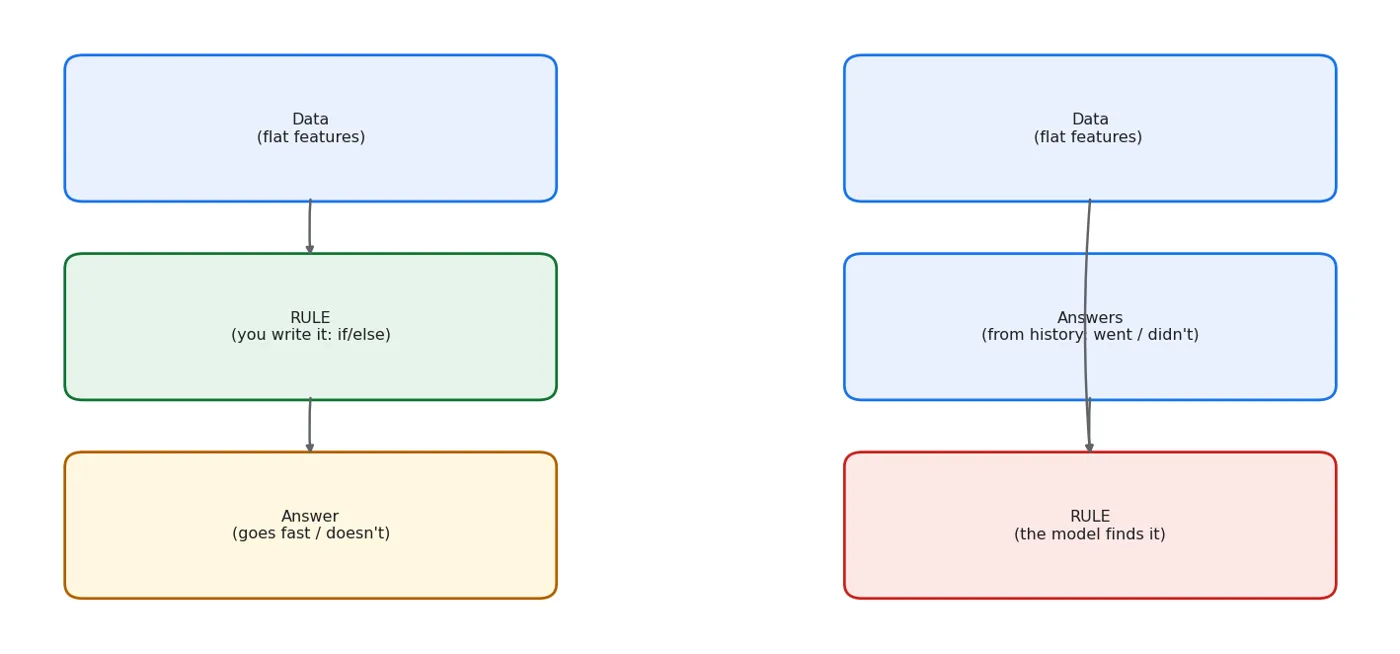
Left: traditional programming. Right: machine learning. The rule and the answer have swapped places.
The single idea behind every algorithm
You'll see dozens of algorithms in this book. All of them do one thing:
Y = f(X)
- X is what you know (number of rooms, area, district, distance to the metro)
- Y is what you want to know (will it go fast)
- f is the rule that connects them
Linear regression, decision trees, neural networks: they differ only in what shape of f they search for. The task is the same.
Column names
The data is synthetic Tashkent rental listings, and its column names are Uzbek. xonalar rooms, maydon_m2 area in m², metro_km distance to the metro, mebel furnished (0/1), narx_usd monthly rent in USD. The target ijaraga_berildi_30k means rented within 30 days.
df = pd.read_csv(DATA / "uy_ijara.csv")
X_example = df[["xonalar", "maydon_m2", "metro_km", "mebel"]].head(5)
y_example = df["ijaraga_berildi_30k"].head(5)
print("X is what the model SEES:")
print(X_example.to_string(index=False))
print()
print("y is the answer the model has to FIND:")
print(y_example.to_string(index=False))
X is what the model SEES:
 xonalar  maydon_m2  metro_km  mebel
       2       40.6      1.43      1
       2       55.5      4.18      1
       5      114.0      3.84      1
       3       72.1      2.99      1
       2       46.4      4.58      0

y is the answer the model has to FIND:
0
0
0
0
1
When you need ML, and when you DON'T
This is the question people skip most. Many projects die right here.
show(pd.DataFrame([
    {"Situation": "The rule is simple and doesn't change", "Need ML?": "NO",
     "Why": "`if age < 18`: doing this with a model is silly"},
    {"Situation": "A rule exists but is very complex", "Need ML?": "YES",
     "Why": "Recognising faces, understanding text: you can't write it by hand"},
    {"Situation": "The rule changes over time", "Need ML?": "YES",
     "Why": "Market prices, fashion, user behaviour"},
    {"Situation": "There is NO data, or very little", "Need ML?": "NO",
     "Why": "You can't build a model from 100 rows; collect data first"},
    {"Situation": "Mistakes are very costly, 100% accuracy needed", "Need ML?": "CAREFUL",
     "Why": "ML never gives 100%. You need human oversight"},
    {"Situation": "You must explain why it answered that way", "Need ML?": "CAREFUL",
     "Why": "Bank loans, medicine. Choose a simple model (Chapter 26, SHAP)"},
]))
| Situation | Need ML? | Why |
|---|---|---|
| The rule is simple and doesn't change | NO | if age < 18: doing this with a model is silly |
| A rule exists but is very complex | YES | Recognising faces, understanding text: you can't write it by hand |
| The rule changes over time | YES | Market prices, fashion, user behaviour |
| There is NO data, or very little | NO | You can't build a model from 100 rows; collect data first |
| Mistakes are very costly, 100% accuracy needed | CAREFUL | ML never gives 100%. You need human oversight |
| You must explain why it answered that way | CAREFUL | Bank loans, medicine. Choose a simple model (Chapter 26, SHAP) |
The first question is not "which algorithm"
On a new project the first question is: "can a simple rule solve this?"
If yes, write the rule. It's faster, cheaper, understandable, and it doesn't break.
In Chapter 7 we measure exactly that: how far a simple rule falls behind ML.
Types of ML
show(pd.DataFrame([
    {"Type": "Supervised", "Data": "X and y: the answers EXIST",
     "Example": "Will the flat go fast; what's the price", "In this book": "Chapters 5-22"},
    {"Type": "Unsupervised", "Data": "Only X: NO answers",
     "Example": "Splitting customers into groups", "In this book": "Chapters 27-29"},
    {"Type": "Reinforcement", "Data": "Actions and rewards",
     "Example": "Games, robot control", "In this book": "no (a separate field)"},
]))
| Type | Data | Example | In this book |
|---|---|---|---|
| Supervised | X and y: the answers EXIST | Will the flat go fast; what's the price | Chapters 5-22 |
| Unsupervised | Only X: NO answers | Splitting customers into groups | Chapters 27-29 |
| Reinforcement | Actions and rewards | Games, robot control | no (a separate field) |
Most of this book is supervised, because most practical work is.
Classification and regression
Supervised learning splits in two. The difference is only the type of y.
print("Our file has TWO targets, so two different tasks:")
print()
print(f"ijaraga_berildi_30k : {sorted(df.ijaraga_berildi_30k.unique().tolist())}  -> {df.ijaraga_berildi_30k.nunique()} distinct values")
print("  => CLASSIFICATION (predict a label)")
print()
print(f"narx_usd            : {df.narx_usd.min()} .. {df.narx_usd.max()}  -> {df.narx_usd.nunique()} distinct values")
print("  => REGRESSION (predict a number)")
Our file has TWO targets, so two different tasks:

ijaraga_berildi_30k : [0, 1]  -> 2 distinct values
  => CLASSIFICATION (predict a label)

narx_usd            : 225 .. 1515  -> 207 distinct values
  => REGRESSION (predict a number)
show(pd.DataFrame([
    {"": "Classification", "What y is": "A label (category)", "Example": "spam/not spam, 3 kinds of flower",
     "Metric": "accuracy, F1, recall", "In this book": "Chapters 8-10"},
    {"": "Regression", "What y is": "A continuous number", "Example": "price, temperature, time",
     "Metric": "RMSE, MAE, R2", "In this book": "Chapter 15"},
]))
| What y is | Example | Metric | In this book | |
|---|---|---|---|---|
| Classification | A label (category) | spam/not spam, 3 kinds of flower | accuracy, F1, recall | Chapters 8-10 |
| Regression | A continuous number | price, temperature, time | RMSE, MAE, R2 | Chapter 15 |
"A 1-5 star rating": classification or regression?
It can be either, and it's your decision.
As classification, the model sees 3 and 4 as "two different categories" and doesn't know they are close. As regression, the model may output 3.7, and it understands the distance between 1 and 5.
In practice regression often works better for ratings. But you have to try it: don't guess, measure.
The three commands of ML work
Every model in sklearn understands the same three commands. Swap the algorithm and these three stay the same.
from sklearn.model_selection import train_test_split
from sklearn.tree import DecisionTreeClassifier

num = ["xonalar", "maydon_m2", "metro_km", "mebel"]
X, y = df[num], df["ijaraga_berildi_30k"]
X_tr, X_te, y_tr, y_te = train_test_split(X, y, test_size=0.3, random_state=42, stratify=y)

model = DecisionTreeClassifier(max_depth=4, random_state=42)

model.fit(X_tr, y_tr)                       # 1. LEARN
pred = model.predict(X_te)                  # 2. PREDICT
score = model.score(X_te, y_te)             # 3. EVALUATE

print(f"fit()     -> the model learned, from {len(X_tr)} rows")
print(f"predict() -> {len(pred)} predictions, for example: {pred[:8].tolist()}")
print(f"score()   -> {score:.4f}")
fit()     -> the model learned, from 840 rows
predict() -> 360 predictions, for example: [0, 1, 0, 0, 1, 1, 1, 1]
score()   -> 0.7417
We swap the model, and only one line changes:
from sklearn.linear_model import LogisticRegression
from sklearn.ensemble import RandomForestClassifier
from sklearn.neighbors import KNeighborsClassifier

for name, m in [("DecisionTree", DecisionTreeClassifier(max_depth=4, random_state=42)),
                ("LogisticRegression", LogisticRegression(max_iter=2000)),
                ("RandomForest", RandomForestClassifier(n_estimators=100, random_state=42)),
                ("KNN", KNeighborsClassifier())]:
    m.fit(X_tr, y_tr)
    print(f"  {name:20s} score = {m.score(X_te, y_te):.4f}")
  DecisionTree         score = 0.7417
  LogisticRegression   score = 0.7639
  RandomForest         score = 0.6806
  KNN                  score = 0.6917
The key to reading this book
fit / predict / score: these three words are the same for 20 algorithms. That's why learning a new algorithm is easy: you only look for answers to how does it work and when does it fit. The code pattern doesn't change.
Overfitting: memorising vs understanding
In the table above the DecisionTree has max_depth=4. Why did I set a limit? What happens if I remove it?
print(f"{'max_depth':>10} {'train score':>12} {'test score':>11} {'gap':>8}")
print("-" * 44)
for d in [2, 4, 8, 15, None]:
    m = DecisionTreeClassifier(max_depth=d, random_state=42).fit(X_tr, y_tr)
    tr_s, te_s = m.score(X_tr, y_tr), m.score(X_te, y_te)
    flag = "   <-- MEMORISED" if tr_s - te_s > 0.15 else ""
    print(f"{str(d):>10} {tr_s:>12.4f} {te_s:>11.4f} {tr_s-te_s:>8.4f}{flag}")
 max_depth  train score  test score      gap
--------------------------------------------
         2       0.6952      0.7611  -0.0659
         4       0.7048      0.7417  -0.0369
         8       0.7869      0.7139   0.0730
        15       0.9143      0.6778   0.2365   <-- MEMORISED
      None       1.0000      0.6583   0.3417   <-- MEMORISED
With the limit removed, the tree becomes almost perfect on train, and gets worse on test.
That is overfitting: the model didn't learn the rule, it memorised the answers.
show(pd.DataFrame([
    {"Case": "Underfitting", "Train score": "LOW", "Test score": "LOW",
     "Cause": "The model is too simple", "Fix": "A stronger model, more features"},
    {"Case": "Good", "Train score": "Good", "Test score": "Good, and close",
     "Cause": "A balance was found", "Fix": "This is where you stop"},
    {"Case": "Overfitting", "Train score": "VERY HIGH", "Test score": "LOW",
     "Cause": "The model memorised", "Fix": "Simplify, regularise, get more data"},
]))
| Case | Train score | Test score | Cause | Fix |
|---|---|---|---|---|
| Underfitting | LOW | LOW | The model is too simple | A stronger model, more features |
| Good | Good | Good, and close | A balance was found | This is where you stop |
| Overfitting | VERY HIGH | LOW | The model memorised | Simplify, regularise, get more data |
This is the bias-variance tradeoff, and Chapters 12-14 open it up mathematically. For now one thing is enough: if the train score is much higher than the test score, don't trust it.
The exam analogy
A student prepares for an exam. There are two ways:
- Understand the topic -> can answer a new question too
- Memorise the answers -> can answer exactly those questions, nothing else
The second student scores 100% on the homework problems (high train score) and fails the exam (low test score).
A model is exactly the same. That's why we test it on data it has not seen (Chapter 6).
Key terms
show(pd.DataFrame([
    {"Term": "Feature", "Meaning": "An input column: X", "In our data": "xonalar, maydon_m2, tuman"},
    {"Term": "Target", "Meaning": "The column being predicted: y", "In our data": "ijaraga_berildi_30k"},
    {"Term": "Sample", "Meaning": "One row", "In our data": "One listing"},
    {"Term": "Label", "Meaning": "A target value in classification", "In our data": "0 or 1"},
    {"Term": "Train", "Meaning": "The part the model learns from", "In our data": "840 rows"},
    {"Term": "Test", "Meaning": "The part the model hasn't seen", "In our data": "360 rows"},
    {"Term": "Hyperparameter", "Meaning": "A setting YOU choose", "In our data": "max_depth=4"},
    {"Term": "Parameter (weight)", "Meaning": "A number the model learns ITSELF", "In our data": "coefficients"},
]))
| Term | Meaning | In our data |
|---|---|---|
| Feature | An input column: X | xonalar, maydon_m2, tuman |
| Target | The column being predicted: y | ijaraga_berildi_30k |
| Sample | One row | One listing |
| Label | A target value in classification | 0 or 1 |
| Train | The part the model learns from | 840 rows |
| Test | The part the model hasn't seen | 360 rows |
| Hyperparameter | A setting YOU choose | max_depth=4 |
| Parameter (weight) | A number the model learns ITSELF | coefficients |
Hyperparameter vs parameter: don't mix them up
A parameter is a number the model finds itself during fit() (a line's coefficient, a tree's split threshold).
A hyperparameter is a setting you choose BEFORE fit() (max_depth, n_estimators, C).
One of the most common pairs in interviews. Chapter 24 is about choosing hyperparameters.
What we learned today
show(pd.DataFrame([
    {"Concept": "The essence of ML", "In one sentence": "You don't write the rule; the model finds it in the data"},
    {"Concept": "Y = f(X)", "In one sentence": "Every algorithm does this, it just searches for f differently"},
    {"Concept": "When ML isn't needed", "In one sentence": "When the rule is simple or the data is scarce"},
    {"Concept": "Classification / regression", "In one sentence": "The only difference is the type of y: a label or a number"},
    {"Concept": "fit / predict / score", "In one sentence": "The same three commands for 20 algorithms"},
    {"Concept": "Overfitting", "In one sentence": "Train high, test low: the model memorised"},
]))
| Concept | In one sentence |
|---|---|
| The essence of ML | You don't write the rule; the model finds it in the data |
| Y = f(X) | Every algorithm does this, it just searches for f differently |
| When ML isn't needed | When the rule is simple or the data is scarce |
| Classification / regression | The only difference is the type of y: a label or a number |
| fit / predict / score | The same three commands for 20 algorithms |
| Overfitting | Train high, test low: the model memorised |
Next chapter: data usually isn't in a CSV, it's in a database. How do we get it out?
Questions about this chapter?
The course, homework review and the other five books are in Uzbek. Questions in English are welcome on Telegram.